
Employment Law in Nigeria for Foreign Companies
(Reflecting legal standards as of December 2025, under the Labour Act, Pension Reform Act 2014, Immigration Act 2015, and 2024/2025 updates.)
Hiring in Nigeria gives foreign companies access to one of Africa’s most dynamic workforces, but understanding employment law in Nigeria for foreign companies is essential for compliant hiring and workforce management.
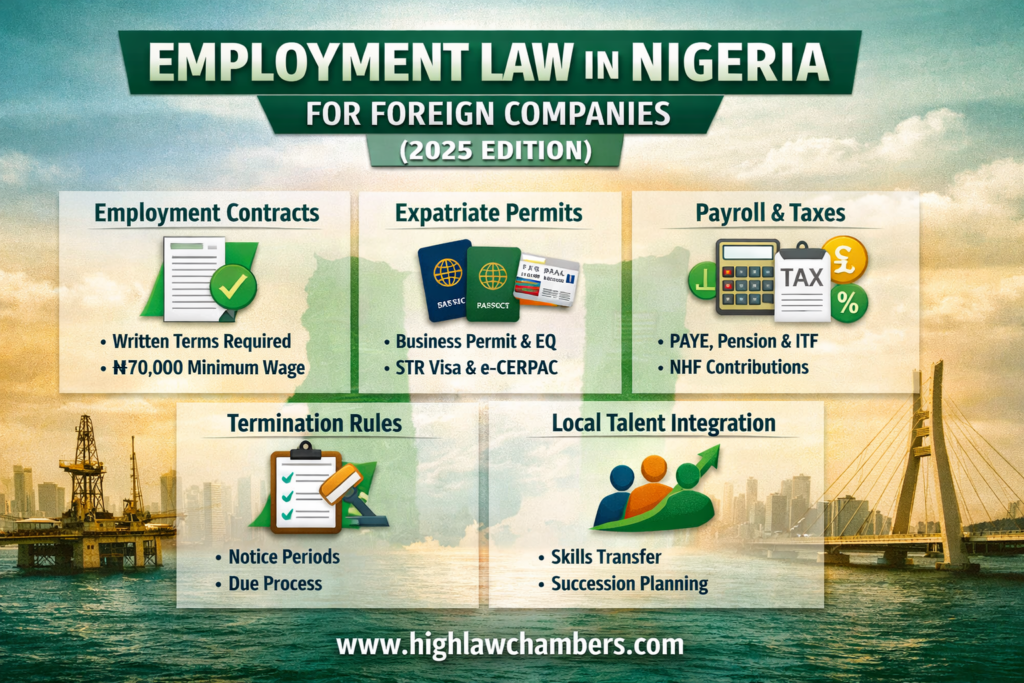
1. Employment Contracts and Hiring Rules in Nigeria
Written Employment Contracts
Under Section 7 of the Labour Act, every employer must provide a written statement of employment terms within three months of an employee starting work. While prompt issuance is encouraged as a management best practice, the three-month statutory window remains the legal standard.
Mandatory Terms
Contracts must clearly state:
- Job title and specific duties.
- Wages, method of calculation, and payment intervals.
- Hours of work, holiday provisions, and sick leave.
- Notice periods for termination.
- Governing Law: Contracts for Nigerian employees must be governed by Nigerian law to ensure local enforceability.
Minimum Wage (2025)
The National Minimum Wage (Amendment) Act 2024 is fully in effect, setting the floor at ₦70,000 per month. This applies to all employers with 25 or more employees. Paying below this threshold renders the contract voidable and attracts penalties.
Expatriate Dual Contracts
For foreign staff, a local Nigerian contract is required for CERPAC and tax compliance, even if a separate offshore agreement handles global benefits.
2. Expatriate Employment and Work Permits
Foreign entities must comply with the Immigration Act 2015 and the Nigeria Visa Policy (NVP) 2025. Immigration compliance is administered by the Nigeria Immigration Service (NIS): https://www.immigration.gov.ng
Core Requirements
- Business Permit: Mandatory for foreign-owned entities before hiring expatriates.
- Expatriate Quota (EQ): Grants approval for specific foreign positions; managed through the Ministry of Interior.
- Subject to Regularization (STR) Visa: The necessary entry visa for long-term foreign staff.
- e-CERPAC: Residence permits are now primarily processed through the Nigeria Immigration Service (NIS) Digital Portal, streamlining biometrics and issuance.
Expatriate Employment Levy (EEL)
The EEL (approximately $15,000 for directors and $10,000 for other staff) was introduced as an administrative policy. While its enforcement has seen periods of suspension for stakeholder review, it remains on the government’s agenda. Employers are encouraged to verify the active collection status with the NIS during their annual budgeting cycles.
Localization Best Practices
Statutes do not currently mandate a “digital upload” of understudy logs, but the Ministry of Interior encourages evidence of skills transfer (mentorship records) during quota renewals. Proactive documentation of Nigerian understudies is a highly recommended compliance strategy.
3. Payroll, Tax, and Statutory Contributions
Foreign employers are responsible for deducting and remitting the following:
| Obligation | Rate / Rule | Legal Basis |
| Personal Income Tax (PAYE) | Graduated 7–24% | PITA (2011 as amended) |
| Pension Contributions | 10% Employer + 8% Employee | Pension Reform Act 2014 |
| Industrial Training Fund (ITF) | 1% of annual payroll | ITF Act 2011 (Employers with 5+ staff) |
| Employee Compensation (NSITF) | ~1% of payroll | Employee Compensation Act 2010 |
| National Housing Fund (NHF) | 2.5% of basic salary | NHF Act 1992 (Voluntary in many private sectors) |
Note: For the NHF, while the 1992 Act remains on the books, enforcement in the private sector is largely voluntary following the Business Facilitation Act’s influence on streamlining deductions.
4. Termination and Employee Rights
Termination is governed by the Labour Act and the evolving precedents of the National Industrial Court of Nigeria (NICN).
- Notice Periods: Generally range from one week to one month, depending on the length of service.
- Termination “Without Cause”: Legally permissible if the employer provides the required notice or “salary in lieu of notice.” However, the NICN encourages employers to document reasons to mitigate “unfair labor practice” claims.
- Disciplinary Due Process: For misconduct, employers should issue a written “query” and allow the employee to respond. This procedural fairness is a key shield against litigation.
5. Workforce Localization
While Nigeria emphasizes the gradual transfer of expatriate roles to locals, this is best managed through structured internal mentorship and formal training programs.
HighLaw Chambers assists multinational companies in:
- Drafting contracts that align with the applicable laws and policies
- Navigating the NIS Digital Portal for quota and CERPAC renewals.
- Advising on balanced employee/employer rights and termination strategies to prevent NICN disputes.
If you missed earlier context, read Regulatory, Tax, and Immigration Compliance Essentials for Foreign Investors in Nigeria
Next in the series: Cross-Border Contracting: Essential Legal Protections for Overseas Companies Working With Local Partners